Why Accessibility is Essential
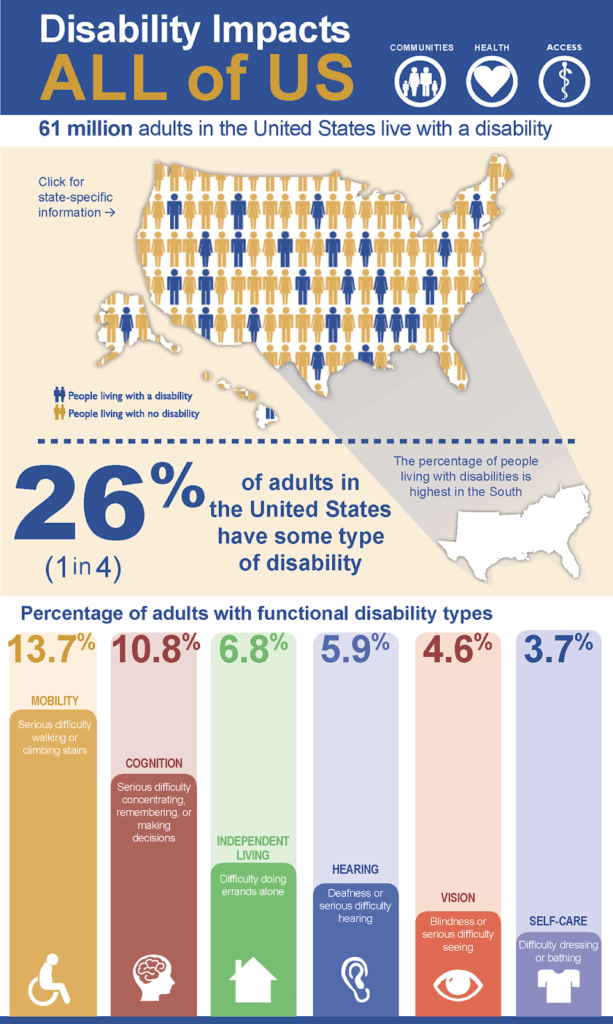
According to the CDC (Center for Disease Control and Prevention) more than 1 in 4 Americans have a disability in 2020. source
These humans deserve an equal experience and the government and agencies have created laws and guidelines to help ensure all Americans have equal opportunity, including online.
Of the 26% cited by the CDC, these stand out regarding the online experience.
13.7% challenged with mobility.
At the same time these humans may rely on online resources all the more, the same things affecting their mobility may affect their ability to navigate a website or app.
10.8% challenged with cognition.
While every website should be intuitive, these humans struggle more to make sense of what they experience and depend on clarity and organization. They are thrown more easily into confusion.
5.9% challenged with hearing.
Applying mostly to video, which is an ever growing part of the Internet experience, these humans live without the full benefit of sound and rely on reading what they cannot hear.
4.6% challenged with vision.
Perhaps none are more deprived of the online experience than those lacking full sight. While online experiences are largely visual, screen reading technology can effectively create an equal experience given a properly constructed webpage.
Others have listed challenges in this order, related to the online experience.
- Vision
- Hearing
- Motor skills
- Cognitive impairment
- Speech
- Reading
- Seizures
While predatory attorneys may be increasingly scaring hard-working enterprises into out-of-court settlements, our primary motivation should come from compassion and a desire to ensure an equal experience for all.
We should make the most accommodation for those challenged at the base of Maslow’s hierarchy for what our websites intentionally provide. These humans are most vulnerable; the legal system is justifying in protecting them.

Even as our businesses and websites meet needs higher in the hierarchy, we must give all an equal experience.
Law & Guidelines
The year 2020 is the 30th anniversary of the Americans with Disabilities Act further protecting human rights.
Websites with significant inaccessible components can be seen as discriminatory against persons with disabilities, in violation of Title III of the ADA. Title III is being interpreted to include websites as “places of public accommodation”.
No current legal prescription exists for web accessibility for private entities in the U.S. but W3C’s Web Content Accessibility Guidelines (WCAG) 2.0 of 2008, with its success criteria of 38 requirements, is frequently referenced by courts. In 2018, WCAG 2.1 added 12 more requirements to achieve Level AA. Government resources are held to a higher “Level AAA” standard according to Section 508.

Bottom Line
Humans with disabilities should be a priority, rather than be an afterthought.